I Left for a Month and Came Back to a Different Decade
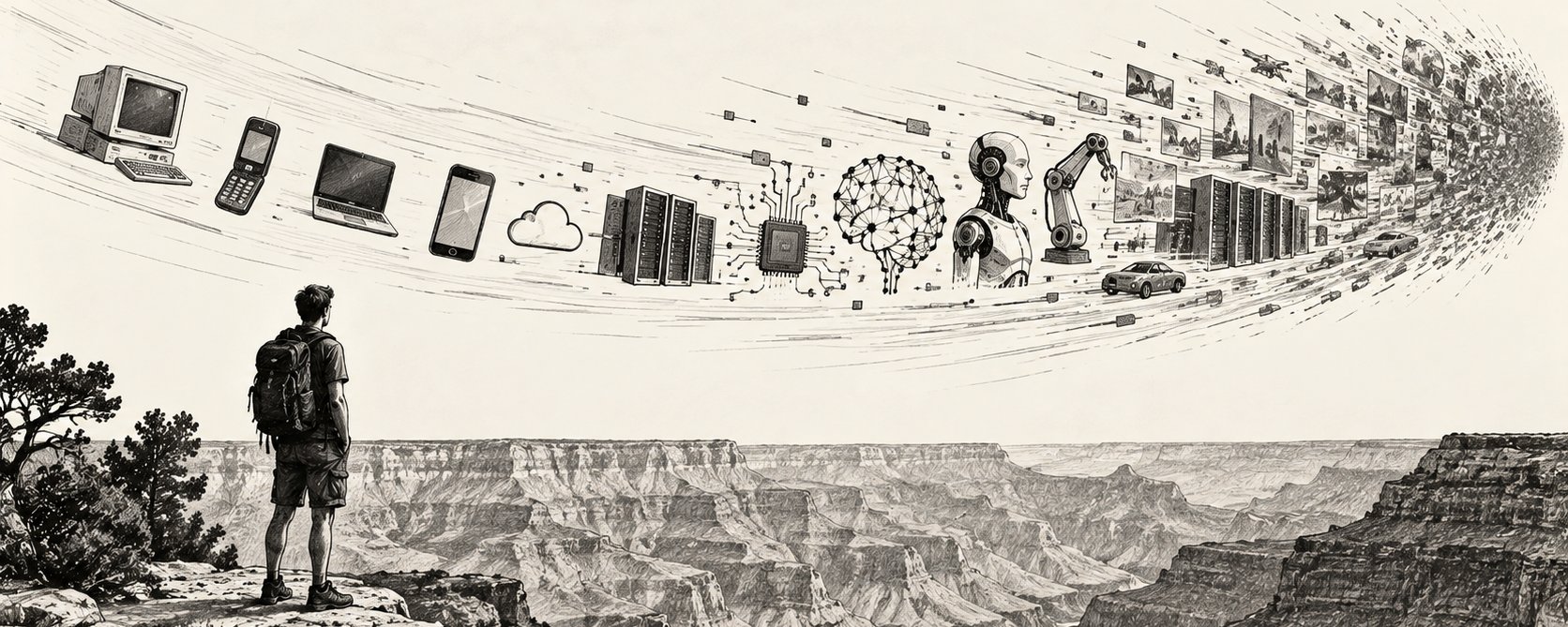
The singularity was supposed to be a date. I found out on a road trip that it is a speed.
I did not go looking for the singularity in August. I went on a road trip with my brother, from Los Angeles through Las Vegas to the Grand Canyon and New Mexico, and for four weeks I did not follow AI. No model launches, no benchmarks, no threads.
When I came back, the tools I use every day had new versions. The way my team worked had changed. Things we had been planning to do "someday" had been done by someone else, in an afternoon, with a model that did not exist when I left. Four weeks away felt like a year.
That feeling has a name, and the name is older than most people think.
In 1993 a mathematician called Vernor Vinge stood up at a NASA symposium and said that within thirty years we would build something smarter than us, and that after that point "our models must be discarded and a new reality rules" (Vinge, 1993). He called it the Singularity. Ray Kurzweil later gave it a year: 2045 (Kurzweil, 2024).
I don't think we are waiting for a year anymore. I think the thing already arrived, and it did not arrive as an event. It arrived as a change in how fast a week goes by.
The numbers, in one sitting
In January 2023 ChatGPT reached a hundred million users in two months. TikTok had needed nine months, Instagram two and a half years (Reuters, Feb 2023). Three years later the app crossed a billion monthly users, faster than Google Maps or YouTube ever did (Reuters, Jun 2026). Google's Gemini crossed a billion in August (TechCrunch, Aug 2026). More than half of American employees now use AI at work (Gallup, 2026).
So far that is only people signing up. The stranger numbers are about what the machines can do.
The research group METR measures how long a task an AI can finish on its own. Since 2023 that length has been doubling roughly every four months (METR, Jan 2026). In May their best estimate for the strongest model was a task of about sixteen hours, with a footnote that their test suite cannot measure much beyond that (METR, 2026). Cursor, the coding tool, published examples of agents running for thirty and thirty-six hours, and one user who "kicked off a 52-hour task" and came back to a finished pull request (Cursor, Feb 2026).
At Google, three quarters of new code is now written by AI and approved by engineers (Pichai, Apr 2026). At Anthropic the finance chief puts it at "90 percent plus" (TechSpot, May 2026). The engineer who leads Claude Code says he has not typed a line by hand in months and ships more than twenty changes a day (Fortune, Jan 2026).
And the money. Microsoft, Amazon, Google and Meta have told investors they will spend about 730 billion dollars on data centers this year, up almost 80 percent on last year, which was itself a record (I/O Fund, Aug 2026). While the price of using the models, for the same quality, falls about ten times every year (a16z, 2024).
What it does to a calendar
In the first two days of this month, Anthropic, Google and Meta each shipped a new frontier model. OpenAI followed within the week (release tracker, Sep 2026). A benchmark called ARC-AGI-3 launched in March; the best model scored 0.37 percent. By September one scored 62.7 (ARC Prize, Sep 2026). Stanford's yearly report puts it plainly: tests designed to last for years "are saturated in months" (Stanford AI Index, 2026).
People feel this in their bodies before they can name it. A Harvard Business Review study of 1,500 workers found a condition they called "brain fry", mental fatigue from overseeing too many AI tools at once (BCG, Mar 2026). Burnout mentions in Glassdoor reviews are up 65 percent in a year (HR Dive, May 2026). One career coach said it best: "It almost feels like a big shift is happening every week" (HR Dive, May 2026).
When people say the year went fast, this is what they mean. What used to be a quarter of change now fits in two weeks, and nobody agreed to that.
The people who build it say the same thing
On 12 September Dario Amodei, whose company makes Claude, wrote that "since roughly this summer, AI has been advancing drastically faster, driven primarily by AI's growing ability to build the next generation of AI" (Amodei, Sep 2026). AI building the next AI is exactly what Vinge meant in 1993. Amodei wrote it in an essay asking the industry to slow down and buy "an extra year or two."
Sam Altman said it a year earlier, more gently: "We are past the event horizon; the takeoff has started," and "the singularity happens bit by bit" (Altman, Jun 2025). He also predicted the first one-person billion-dollar company. In May Amodei said the same and gave it a deadline: "seven more months" (VentureBeat, May 2026). Last year a solo founder sold a six-month-old company to Wix for 80 million dollars (Ctech, Jun 2025).
The politicians have caught up too. This month a United States senator introduced a bill to ban superintelligence outright, with prison terms for anyone who builds it (Sanders, Sep 2026). You do not write a law against something you think is decades away.
So I stopped thinking of the singularity as something that walks through a door one day. It is a rate, and you feel a rate as time. That is the singularity I mean, the one where you leave for a month and come back to a different decade.
What I do about it
I don't have a system. I have three habits, and that is it.
- I keep a note called "what changed this month." One line per thing. In 2019 it would have been empty most months. Now it is the most useful document I own.
- I let the machines carry what they can carry. My AI reads my mail, transcribes my meetings, and remembers what I told it. I stopped feeling guilty about that.
- I protect one hour a day where nothing accelerates. A walk, a call with my mother, a meal without a screen. Not because it is productive. Because the people are the only part of this that does not double every four months.
In the second week of the trip my brother and I stood at the edge of the Grand Canyon. The rock at the bottom is close to two billion years old and looks the way it did the last time anyone stood there. It was the only thing I saw all summer that was moving at a speed I was built for.
Sources
History
- Vinge, "The Coming Technological Singularity" (1993): https://edoras.sdsu.edu/~vinge/misc/singularity.html
- Kurzweil, The Singularity Is Nearer (2024), 2029/2045: https://en.wikipedia.org/wiki/TheSingularityIs_Nearer
Adoption
- ChatGPT 100M in two months (Feb 2023): https://finance.yahoo.com/news/chatgpt-sets-record-fastest-growing-190911828.html
- ChatGPT 1B monthly (Jun 2026): https://finance.yahoo.com/sectors/technology/articles/chatgpt-app-hits-1-billion-222139124.html
- Gemini 1B monthly (Aug 2026): https://techcrunch.com/2026/08/11/googles-gemini-app-surges-to-one-billion-users/
- Gallup 52% of US employees use AI at work (2026): https://www.gallup.com/699797/indicator-artificial-intelligence.aspx
Capability
- METR time-horizon doubling ~125 days (Jan 2026): https://metr.org/blog/2026-1-29-time-horizon-1-1/
- METR ~16 h horizon for Claude Mythos, suite unreliable above 16 h (May 2026): https://metr.org/time-horizons/
- Cursor long-running agents, 52-hour task (Feb 2026): https://cursor.com/blog/long-running-agents
- Google 75% of new code AI-generated (Apr 2026): https://blog.google/innovation-and-ai/infrastructure-and-cloud/google-cloud/cloud-next-2026-sundar-pichai/
- Anthropic CFO Krishna Rao, "90%-plus" of code written by Claude (14 May 2026): https://www.techspot.com/news/112408-anthropic-more-than-90-code-now-written-ai.html
- Boris Cherny, 100% AI-written (Jan 2026): https://www.fortune.com/2026/01/29/100-percent-of-code-at-anthropic-and-openai-is-now-ai-written-boris-cherny-roon
Money and cost
- Big four 2026 capex guidance $732.5B, +79% YoY (I/O Fund, 5 Aug 2026): https://io-fund.com/ai-stocks/ai-capex-1-trillion-estimates-too-low
- LLM cost falling 10x per year (a16z, 2024): https://a16z.com/llmflation-llm-inference-cost/
Pace and its cost
- September 2026 releases: Claude Fable 5.1 / Mythos 5.1 (1 Sep), Gemini 3.8 Flash (2 Sep), Muse Spark 1.3 (2 Sep), GPT-6 Astra (first week): https://www.digitalapplied.com/blog/ai-model-releases-september-2026-tracker
- ARC-AGI-3 62.7% (GPT-6 Astra, Sep 2026): https://arcprize.org/blog/astra ; launch score 0.37% (Mar 2026): https://officechai.com/ai/arc-agi-3/
- Stanford AI Index 2026, benchmarks saturate in months: https://hai.stanford.edu/ai-index/2026-ai-index-report/technical-performance
- BCG/HBR "brain fry" (Mar 2026): https://www.bcg.com/news/5march2026-when-using-ai-leads-brain-fry
- Glassdoor burnout +65% (May 2026): https://www.hrdive.com/news/burnout-increasing-employee-confidence-at-a-record-low/820801/
- "Big shift every week" (May 2026): https://www.hrdive.com/news/ai-driven-change-intensifying-mental-health-needs-leaders-leaders-not-ready/821335/
The builders and the politicians
- Amodei, "We Must Pace the Frontier" (12 Sep 2026): https://darioamodei.com/post/we-must-pace-the-frontier
- Altman, "The Gentle Singularity" (Jun 2025): https://blog.samaltman.com/the-gentle-singularity
- Amodei "seven more months" for a one-person $1B company (May 2026): https://venturebeat.com/technology/anthropic-says-it-hit-a-30-billion-revenue-run-rate-after-crazy-80x-growth
- Base44 sold to Wix for $80M after six months (Jun 2025): https://www.calcalistech.com/ctechnews/article/s1iflnlelx
- Sanders and Casar, Ban Artificial Superintelligence Act (Sep 2026): https://www.sanders.senate.gov/press-releases/news-sanders-casar-introduce-legislation-to-ban-artificial-superintelligence-and-temporarily-pause-advanced-ai-development/ ; Axios (3 Sep 2026): https://www.axios.com/2026/09/03/bernie-sanders-superintelligence-ban-ai-pause
Nadir Matti · Originally published on X