My AI Remembers Everything. That Is the Problem.
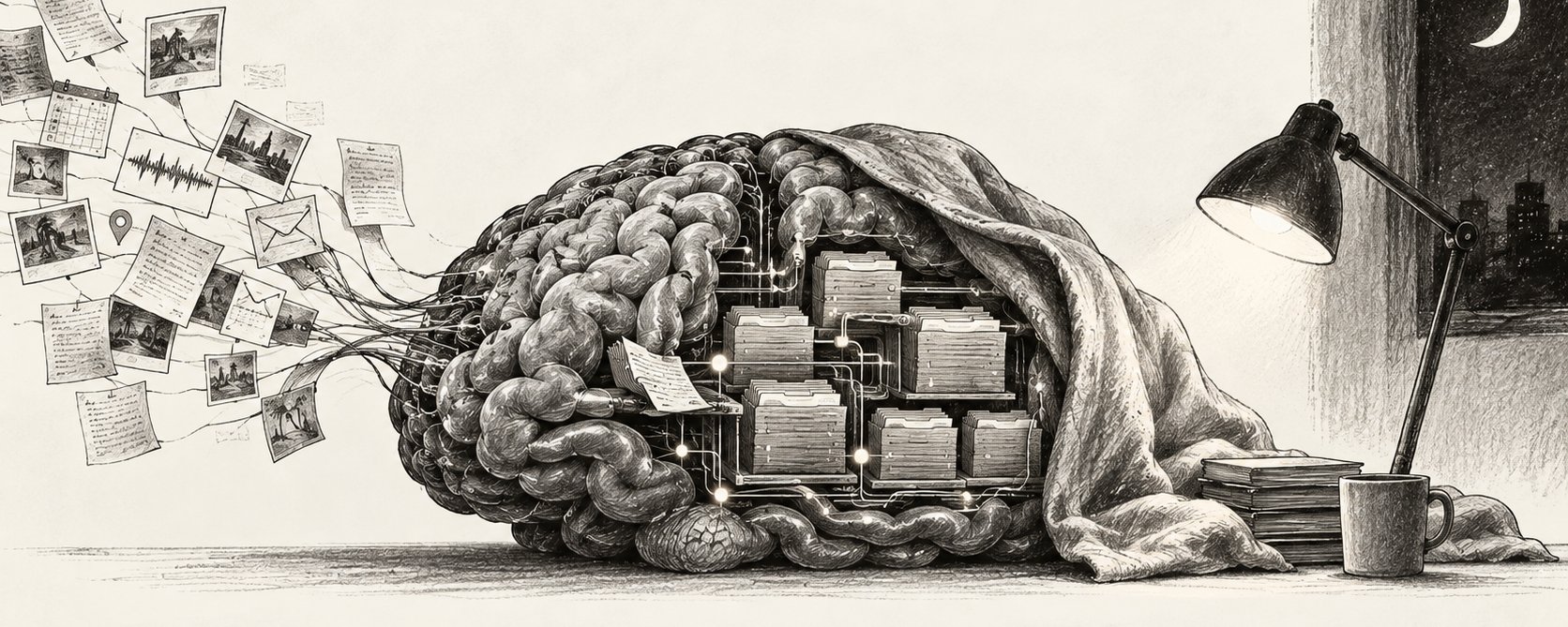
I spent the summer building a machine that knows my life. This week I asked it how memory should work, and the first thing it found was a mistake in itself.
Since July I have been building something I just call the brain. Voice notes from my phone go into it. My mail, my calendar, my sleep ring, the small recorder I wear in my ear at meetings. It lives on a server, it answers me on Telegram, and as of this week it holds 1,640 files about me.
This week I asked it a question I should have asked in July. How should a machine remember a person? Go and read what the researchers say, what the open-source builders have made, and what people who tried this before me learned. It read for a while. Then it came back with one uncomfortable sentence about itself.
Every time I tell it something, it writes a new file. It never checks whether it already knew. Tell it in July that we are going on a business trip abroad and in September that the trip is off and we are staying in Los Angeles, and it keeps both, side by side, with equal weight, forever.
A builder who hit the same wall put it better than I can: "If both facts live in memory with equal standing, the agent will cheerfully cite the wrong one half the time" (BangBoo01, Jun 2026).
How a machine remembers
Here is the thing most people do not know about the AI they talk to. It has no memory between conversations. None. Everything it knows about you in a given moment is whatever text has been placed in front of it, and when the conversation ends that text is gone. Anthropic's engineers describe it as an attention budget, a finite desk, and say the whole craft is deciding what goes on the desk and when (Anthropic, Sep 2025).
So "memory" is not a thing the machine has. It is a routine somebody built around it. After each conversation, a second call pulls out the facts worth keeping. Each fact is compared with what is already stored and the system decides: add it, update the old one, or ignore it. At question time a handful of the most relevant notes are fetched and put on the desk. That is all it is. Claude's own memory, launched in August, is literally a list of files you can open, read and edit, one per topic (Anthropic, Aug 2026). The folder my brain uses is the same idea, just mine.
The newest piece is the strangest. In June OpenAI gave ChatGPT something it calls Dreaming. While you are away, a background process rereads years of your conversations and rewrites what it remembers, so "you're going to Singapore in July" becomes "you went to Singapore in July 2026" once the trip is over. OpenAI says this lifted factual recall on its internal test from 41.5 percent to 82.8 percent. Those are the company's own numbers on a test it has not released (OpenAI, Jun 2026; Tech Times, Jun 2026). But the idea itself is the point. The machine gets better at remembering you by sleeping on it.
More memory makes it worse
This was the part I did not expect.
I assumed the answer to a forgetful machine was to give it everything. The research says the opposite. A lab called Chroma tested eighteen models last year and found that when you hand a model the full 113,000-word history of a conversation, it answers worse than when you hand it the 300 words that matter. Every model. The irrelevant context does not sit quietly. It gets in the way (Chroma, Jul 2025). The team behind Mem0, one of the most used open-source memory tools, found that pulling out facts and storing only those beat sending the whole conversation, by a wide margin, using ninety percent fewer words (Chhikara et al., Apr 2025).
The engineers who tried this at home found the same thing in a more painful way. One of them runs an AI memory system across 34 projects. His main memory file had grown to 501 lines. He discovered his tool had been silently cutting it off at line 200, and that "about 60 percent of my accumulated lessons were invisible for days before I noticed" (Paterson, Feb 2026). The machine had not forgotten. It had been handed too much and quietly dropped the rest.
So the hard part is not remembering. Everybody can store. The hard part is forgetting well. Which fact is still true, which one has been replaced, which old note should fade and which should be kept for good.
The best answer anyone has found looks a lot like what a person does. The most popular personal AI agent on GitHub, a project called OpenClaw with close to 400,000 stars, runs a job every night that it also calls dreaming. It looks at what was recalled that week, how often, from how many angles, and promotes the notes that earned it into long-term memory, merging the duplicates and marking the old versions as old (OpenClaw docs, 2026). Andrej Karpathy, who ran AI at Tesla and co-founded OpenAI, published his own version of this in April and wrote that "the tedious part of maintaining a knowledge base is not the reading or the thinking, it's the bookkeeping," and that this is exactly the work a machine will never get bored of (Karpathy, Apr 2026).
What I am changing
Three things, in plain words.
- It checks before it writes. From now on, when I tell it something, it looks for the five closest things it already knows and decides whether this is new, an update, or a replacement. The two notes about the trip will become one, with a date.
- Every fact gets two dates and nothing is deleted. When it happened, and when I told it. When something stops being true, the old note stays, marked as old. I want to be able to ask what I believed in March.
- It sleeps. A pass every night, in its own quiet session, that merges, promotes and lets things fade. It edits memory. It never messages me. I turned off the nudges weeks ago and I am not turning them back on.
Somewhere in the brain, right now, we are still going on that trip. Nobody told the file from July. Next week I will.
Sources
How memory works
- Anthropic, "Effective context engineering for AI agents" (Sep 2025): https://www.anthropic.com/engineering/effective-context-engineering-for-ai-agents
- Anthropic, "Claude's memory works everywhere and you decide what's in it" (25 Aug 2026): https://claude.com/blog/claudes-memory-works-everywhere-and-you-decide-whats-in-it
- OpenAI, ChatGPT memory "Dreaming" (4 Jun 2026): https://openai.com/index/chatgpt-memory-dreaming/ ; figures via Tech Times: https://www.techtimes.com/articles/317840/20260605/chatgpt-memory-dreaming-update-openai-rewrites-personalization-engine-limits-audit-trail.htm
More is worse
- Chroma, "Context Rot," 18 models, focused vs full LongMemEval input (14 Jul 2025): https://www.trychroma.com/research/context-rot
- Chhikara et al., "Mem0: Building Production-Ready AI Agents with Scalable Long-Term Memory," 26% over OpenAI memory, 90%+ token savings (Apr 2025): https://arxiv.org/abs/2504.19413
- Ian Paterson, "Claude Code Memory System," 501 lines, 200-line cap, 60% invisible (22 Feb 2026): https://ianlpaterson.com/blog/claude-code-memory-architecture/
Forgetting well
- BangBoo01, "The hard part of agent memory isn't remembering, it's forgetting" (22 Jun 2026): https://dev.to/01_a125211d8c3da3fdcfd/the-hard-part-of-agent-memory-isnt-remembering-its-forgetting-ai3
- OpenClaw, dreaming and memory docs (2026): https://docs.openclaw.ai/concepts/dreaming and https://docs.openclaw.ai/concepts/memory ; repository ~390k stars as of 15 Sep 2026: https://github.com/openclaw/openclaw
- Andrej Karpathy, "LLM Wiki" (4 Apr 2026): https://gist.github.com/karpathy/442a6bf555914893e9891c11519de94f
Nadir Matti · Originally published on X